Daloy Dance Company to Represent the Philippines at 2026 World Island Fair in Yeosu, South Korea
September 16, 2026
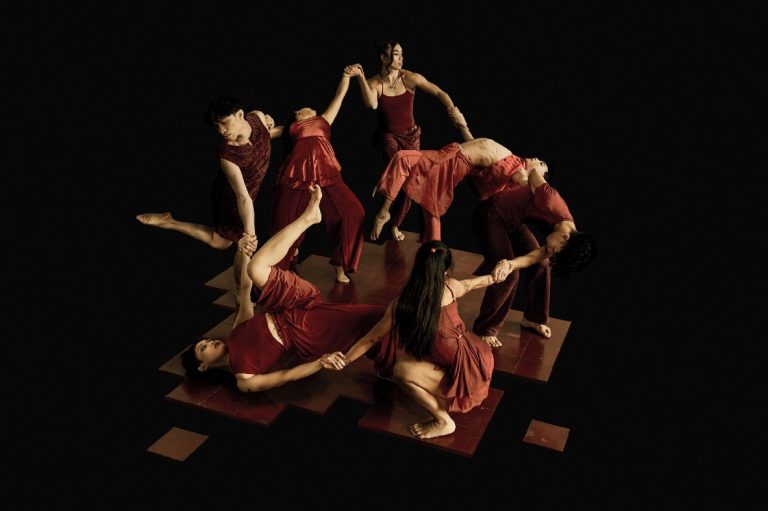
Live performance, Daloy Dance Company
Selected films from Ea Torrado’s Bari-Bari will meet the live performance of Agos, a new work choreographed by Julienne Depatillo and Sebio Guevara.
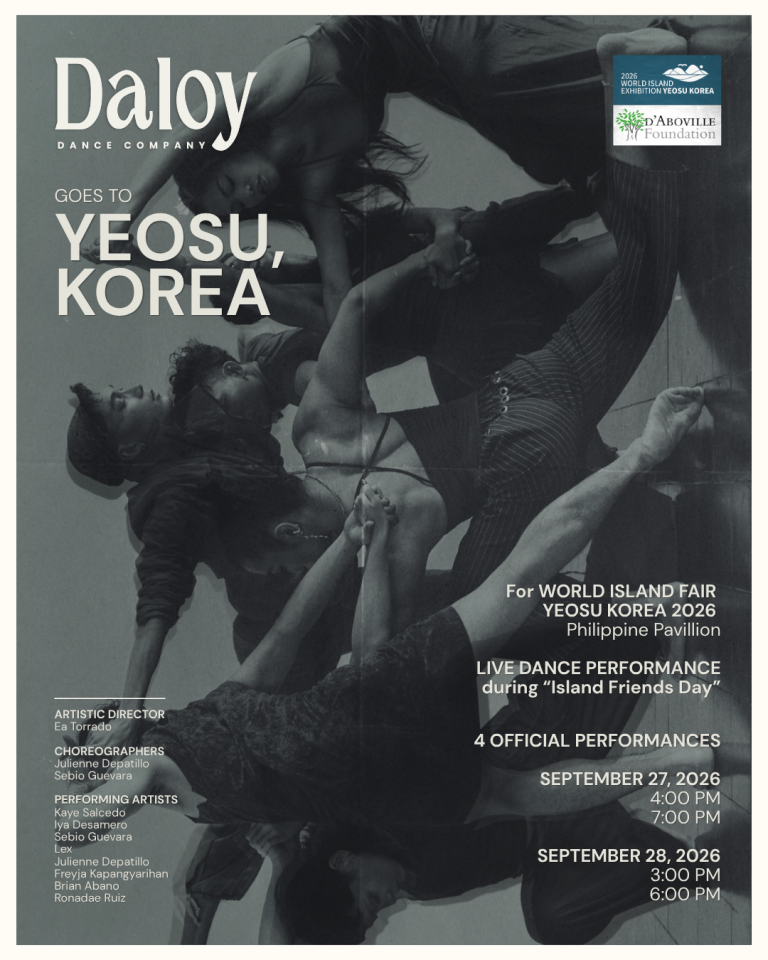
Daloy Dance Company is heading to Yeosu, South Korea, this September to represent the Philippines at the 2026 World Island Fair, bringing together contemporary dance, film, and ecological storytelling in four performances on September 27 and 28.
Led by founder and artistic director Ea Torrado, the company will present a layered encounter between two distinct works: selected excerpts from Torrado’s environmental dance-film project Bari-Bari and the live performance of Agos, choreographed by emerging Daloy artists Julienne Depatillo and Sebio Guevara.
The performances are presented in connection with the Philippine Pavilion, which places Puerto Galera and Mindoro at the heart of an immersive exhibition exploring contemporary art, marine biodiversity, Mangyan cultural heritage, Tamaraw conservation, environmental education, and eco-cultural tourism.
Daloy’s participation is co-produced by the D’Aboville Foundation and Demo Farm, Inc., a French-Filipino nonprofit organization that has worked in Mindoro since 2004, with programs spanning environmental conservation, Indigenous rights, cultural heritage, sustainable agriculture, and responsible tourism.
Connecting La Union, Mindoro, and Yeosu
For Torrado, the invitation brings together several concerns that have long shaped her life and artistic practice, including island communities, humanity’s relationship with nature, environmental responsibility, international cultural exchange, and the development of younger Filipino artists.
The project also gives Daloy an opportunity to revisit Bari-Bari, a work developed during Torrado’s experience of living in La Union, and place it in conversation with a new generation of artists.
The resulting presentation connects three places through water: La Union, where Bari-Bari was created; Mindoro, whose natural and cultural heritage is represented by the Philippine Pavilion; and Yeosu, the Korean maritime city hosting the World Island Fair.
Although presented together, Bari-Bari and Agos remain separate works, each with its own creative process, movement language, and artistic identity.
Agos is neither an adaptation nor a continuation of Bari-Bari. Instead, Daloy’s presentation allows audiences to experience two generations and expressions of the company’s ecological practice at the same time.
As Agos is performed live, the landscapes and moving bodies of Bari-Bari will create a visual environment around the dancers, forming a dialogue between film and live performance, past and present, and the artistic voice of Daloy’s founder and those of its younger choreographers.
About Bari-Bari
Created in 2020–2021, Bari-Bari was exhibited at Konsum in der Kunst at Museum Biberach in Germany and produced for Company Christoph Winkler’s European project Environmental Dances, an international initiative exploring how dance, cultural knowledge, and personal experience can make the climate crisis more tangible.
The title comes from an Ilokano expression related to the Filipino phrase tabi-tabi po. Traditionally spoken when passing through places where elemental spirits may dwell, the expression communicates reverence, respect, and the intention to do no harm.
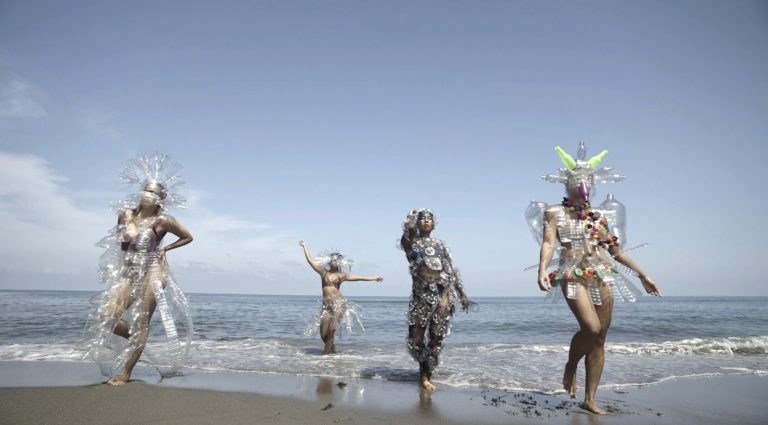
Bari-Bari was co-directed by Torrado and videographer Chino Neri, with costumes by internationally recognized Filipino visual artist Leeroy New. The project combines movement, interviews, environmental testimony, and images of bodies moving through the land and waters of La Union.
Agos and a new generation of Daloy artists
Agos approaches environmental care through the choreographic voices of Depatillo and Guevara. Daloy gave the choreographers the opportunity to create their own response to contemporary ecological concerns.
Through their distinct choreographic language, the artists explore interconnectedness, community, collective responsibility, and humanity’s relationship with the environment.
The work stands independently while creating new meanings when experienced alongside Bari-Bari, reflecting Daloy’s commitment not only to creating performances but also to developing a new generation of Filipino choreographers.
Daloy Dance Company will present four official performances at the 2026 World Island Fair: September 27 at 4:00 PM and 7:00 PM, and September 28 at 3:00 PM and 6:00 PM, in Yeosu, South Korea.
Bari-bari film still, L-R: Abee Manotoc, Eisa Jocson, Mia Cabalfin and EM Meneses. Photo by Renz Erykah