
A Number Review: How Far Will a Parent Go for a Second Chance?
By: Inxs Singson Nazareno
October 12, 2026
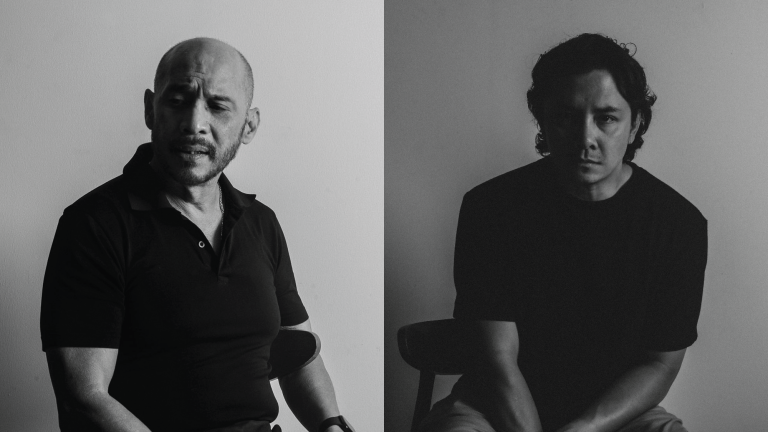
JC Santos makes an impressive directorial debut in an understated yet haunting production that explores fatherhood, identity, and the consequences of trying to rewrite the past.
Caryl Churchill’s A Number is not an easy play to stage. It demands raw talent, precision, and a willingness to experiment, especially in Manila’s thriving theater scene. For JC Santos, choosing this thought-provoking material for his directorial debut is a bold move.
Written in 2002 by the British playwright, A Number explores the ethical and emotional consequences of human cloning. The play emerged in the wake of the scientific breakthrough involving Dolly the Sheep, the first mammal cloned from an adult somatic cell, whose existence sparked worldwide debate about the possibilities and moral implications of cloning. Churchill's work can be seen as a response to the questions raised by this development.
At the heart of the story is Salter (played by Bart Guingona), a father confronted by the existence of multiple versions of his son. Santos takes on three roles—Bernard 1, Bernard 2, and Michael Black—two of whom are clones of the original.
Staged in the intimate space of WHYNoT in Karrivin Studios, the production places its audience around the actors in a 360-degree setting. The minimalist staging features LED screens overhead and holographic-like mirrors that help transition between scenes. With hardly any props apart from a single seat that the actors move around, the production relies heavily on its performers to carry the narrative.
For his first outing as a director, Santos demonstrates a keen understanding of the material and the power of restraint. The production is understated yet haunting, making effective use of its intimate space, minimalist set, and visual elements to create an atmosphere that is both unsettling and deeply personal. Rather than relying on elaborate staging, Santos allows the story and performances to take center stage.
A Number is a production that may require the audience's full attention. Dialogue-heavy and experimental in its approach, it asks viewers to listen closely and follow the shifting conversations between the two characters.
Also deserving of praise is the production's impressive use of lighting, visuals, and sound, thanks to Miguel Uy, and sound artist Frankie Lalunio. The lighting and visual elements create an almost surreal atmosphere, while the sound design heightens the tension and emotional weight of the story. Both elements transform the minimalist space into something visually striking and immersive.
Guingona delivers a deeply relatable portrayal of Salter. Guilt is an ever-present reality of parenthood, often becoming an internal battle between what we have done and what we wish we could undo. As a father desperate for a second chance, Guingona is both believable and empathetic. Even when Salter’s decisions raise difficult moral questions, we understand the emotions driving him. His performance makes us see not just a man who has made questionable choices, but a father struggling with the consequences of his past.
Santos, meanwhile, is magnetic as Bernard 1, Bernard 2, and Michael Black. His ability to shift almost instantaneously between three distinct personalities is a compelling reminder of why he is an award-winning actor, including his Best Supporting Actor win at the Metro Manila Film Festival for Mallari. Each character demands a different emotional register, and Santos navigates these transitions with remarkable control.
What makes his performance particularly fascinating is how distinctly different these three characters are despite sharing the same genetic makeup. Each has his own personality, temperament, and way of responding to the world.
In many ways, A Number is the perfect vehicle to showcase Santos' versatility. The intimate staging leaves little room to hide, allowing audiences to witness every subtle change in expression, movement, and emotion.
A Number raises another compelling question: What truly makes us who we are? Is identity determined by our genes, or is it shaped by the environment in which we grow up, the people who raise us, and the experiences we carry?
Despite coming from the same genetic origins, Bernard 1, Bernard 2, and Michael Black grow into different individuals. Their contrasting personalities suggest that genetics alone cannot determine a person's identity. The circumstances of their upbringing, the relationships they form, and the experiences they endure all contribute to the people they become.
In this sense, Churchill's play is not merely an exploration of the ethical questions surrounding cloning. It also challenges the idea that a person can simply be replicated. Even with identical genetic material, there is no guarantee of creating the same individual. We may inherit our genes, but our experiences help shape who we become.
More than a story about cloning and identity, A Number raises a deeply human question: Can a parent ever truly make up for the mistakes of the past?
Through the performances of Guingona and Santos, what begins as an unsettling premise about human cloning becomes something far more personal—a story about the complicated nature of fatherhood, the formation of identity, and the consequences of wanting to begin again.
Ultimately, A Number reminds us that while science may offer the possibility of creating another life, it cannot necessarily recreate the same person—or undo the mistakes of the one already lived.
A Number runs on October 9–11 and 16–18, 2026, at WHYNoT, 4/F Karrivin Studios, 2316 Chino Roces Avenue Extension, Makati City.
Remaining performances are scheduled for October 16 at 8:00 PM, October 17 at 3:00 PM and 8:00 PM, and October 18 at 3:00 PM and 8:00 PM.
With only 80 seats available per performance.
Tickets are priced at ₱2,800, with free seating, and are available through Ticket2Me.
Bart Guingon and JC Santos. courtesy of WHYNot
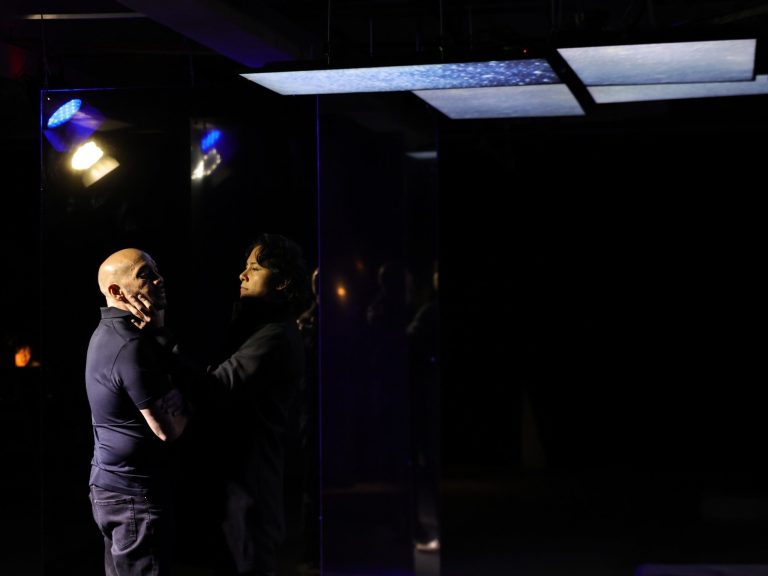
Bart Guingona as father, Salter and JC Santos as Bernard 1 | Photo by Miguel Uy