
Yameya Review: A Haunting Filipino Reimagining That Blends Imagination and Heartbreak
By Matty Haze
July 4, 2026
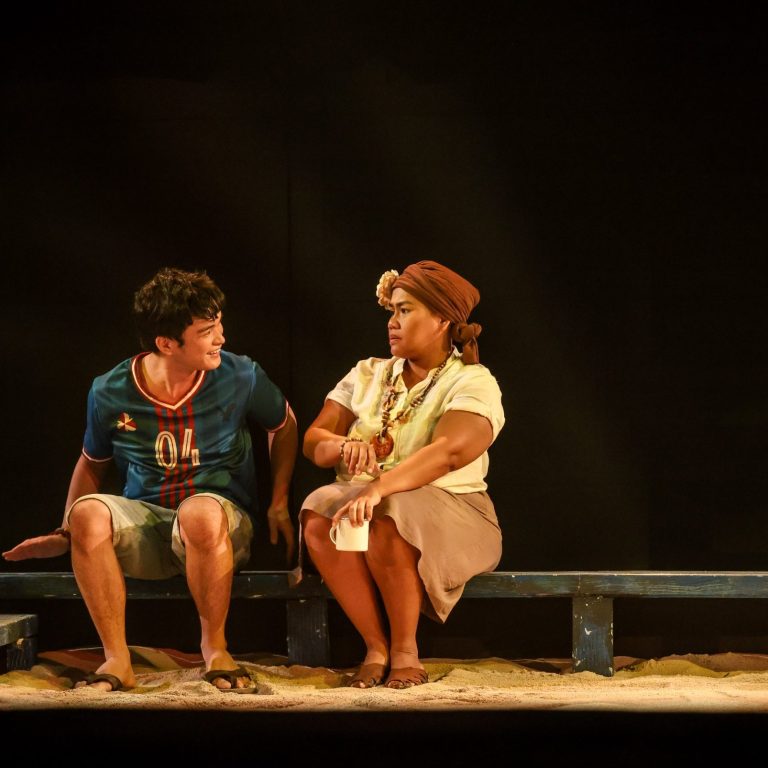
Tommy Alejandrino as Jesus/Mulo and Bituin Escalante as Yemaya | Photo by Myra Ho
Stepping into the Black Box at The Proscenium Theatre, I was treated to a genuinely memorable production of an existing work beautifully translated to fit the Filipino aesthetic. The production is directed by Ed Lacson Jr., a director who already has a string of heavy-hitting local credits like Himala: Isang Musikal (2018), Stop Kiss (2019), and Tao Po (2017) under his belt. Pair his directorial vision with the brilliant foundation laid by original playwright Quiara Alegría Hudes, a celebrated Pulitzer Prize winner known for massive international hits like In the Heights (2007), Water by the Spoonful (2011), and Elliot, A Soldier’s Fugue (2006), and the expectations are understandably sky-high. When a creative team possesses a pedigree this heavy, a production faces immense pressure to perform.
Fortunately, Yameya does not just reach for those high expectations, it actively grasps them.
The Call of the City: Leaving Innocence Behind
The narrative journey of Yemaya begins in a quiet, isolated world, centering on a young boy named Jesus, though he is more commonly known as Mulo. Mulo is the epitome of a naive protagonist, living a peaceful but deeply monotonous life up in the mountains. He enjoys the simple existence his rural home provides, but the sheer, unyielding boredom of his daily routine eventually catches up to him. Seeking any form of excitement or escape from the monotony, he decides to follow a fellow villager, Jelin, who is planning a trip away from the mountains. Together, they embark on an fateful journey down to the sprawling city. Once he arrives, Mulo is immediately thrust into a chaotic urban environment, experiencing sights, sounds, and hardships far beyond his wildest imagination. Rather than discouraging him, this sensory overload fuels a starry-eyed, incredibly naive desire to see the President and eventually find a way to sail off to America.
Creative Liberties, Lasting Impact
The play offers an incredibly compelling and fascinating reimagining of a classic adventure story. Thanks to some smart, highly localized creative liberties taken by the production team, the narrative remains entirely accessible to a modern audience while keeping its emotional core front and center. The pacing is handled beautifully, ensuring that the heavy impact of the story is ever-present rather than saved entirely for the final act. Because of its open-ended nature, the play avoids tying everything up in a neat, predictable bow. Instead, I left the theater with a lingering sense of curiosity, turning over questions in my mind about where these characters could possibly go next.
The overall quality of the production is so impressive that any initial skepticism dissolves, leaving you completely glued to the stage the exact moment the journey takes off.
From Playful Tournaments to Morally Gray Worlds
The cast assembled for Yemaya is an incredibly engaging and talented bunch. Their chosen acting style walks a fascinatingly fine line between grounded, believable realism and heightened, theatrical exaggeration. A perfect example of this stylistic balance is a scene where the characters gather to play a casual game of dominoes. Through sheer performance energy, the cast transforms this simple tabletop pastime into something resembling a high-stakes gambling event that keeps the entire audience utterly captivated by every single tile placement. Tommy Alejandrino is fantastic as Mulo, bringing a relentless, energetic, and wide-eyed dreaminess to the central protagonist. His portrayal of an innocent boy who undergoes severe hardships while stubbornly refusing to let go of his grand ambitions gives the story its profound emotional depth. Meanwhile, Sheena Belarmino delivers an equally stellar performance as his companion, Maya. Playing the character with a mysterious, morally gray edge, Belarmino provides an excellent foil to Mulo’s innocence, serving as his enigmatic and unpredictable ticket into the complexities of this strange new world.
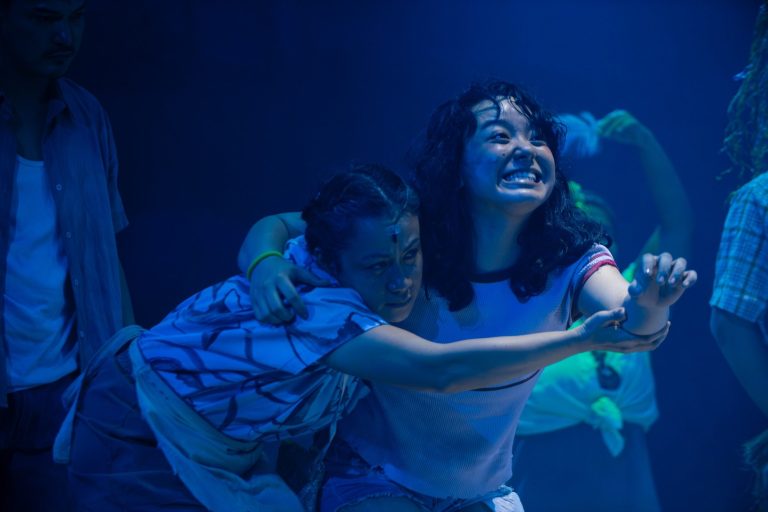
Sheena Belarmino as Maya | Photo by Dan Esguerra
Shattered Beliefs: A Haunting Portrait of Pain and Sorrow
Within these performances, a major emotional standout moment occurs when Mulo lets out a raw, agonizing scream of pure pain and sorrow. It is a truly haunting peak in the production, one that has been beautifully built up by the sequence of tragedies and disillusionments the young boy has endured throughout his travels. The moment hits the audience with full force because it marks the exact second his deeply held illusions shatter irrevocably right in front of him. In contrast to this loud, devastating climax, the play also excels in its quieter character interactions. Another beautiful moment happens when Maya shows a flash of genuine, deeply felt concern for Mulo. It is a subtle but powerful shift in her otherwise guarded demeanor, proving an unexpected emotional anchor given that she has not actually known him for very long.
Shattered Illusions and Quiet Anchors: The Play's Striking Emotional Range
The supporting cast features some excellent standouts who ground the world surrounding the two leads. Anthony Falcon plays Jelin, the fellow villager who acts as a chaotic older brother figure to Mulo. Falcon’s role starts with a clear sense of mischief and self-interest on his mind, but as the situation in their hometown grows increasingly perilous, his performance shifts beautifully. He adopts a mature, adult perspective, executing a protective turnaround as he does his absolute best to be there for Mulo when the boy needs it most. Then there is Lila, brought to life with wonderful pragmatism by Sheenly Gener. As a local store owner who offers Mulo a future deal to eventually purchase her business, her grounded, deeply realistic worldview creates a fantastic narrative friction. Her practical advice stands as a harsh, unyielding wall against Mulo’s stubbornly naive assumptions about how the world operates.
Suspended Worlds and Unmasked Stagecraft: The Hypnotic Magic of a Sandy Stage
Visually, the stage design is an absolute triumph of minimalist theatrical imagination. The entire floor of the performance space is completely covered in deep sand, while the various pieces of furniture are seen suspended in mid-air by a system of heavy ropes. During scene transitions, rather than relying on a traditional stage crew running out in the dark, the production quietly lowers the specific objects and furniture pieces needed for the upcoming setting. It is a captivating, almost hypnotic sight to witness. This mechanics-forward design is put to brilliant use in a specific sequence where a suspended structure simulates riding a boat on rough waves, while the sandy floor far below transforms visually into the bottom of the ocean. With no walls, backstage areas, or heavy curtains to hide the stagecraft, the audience is seated entirely around the playing space, granted an intimate, 360-degree view of the theatrical magic unfolding in real time.
Shifting Hues and Haunting Tones
The lighting design does a massive amount of narrative heavy lifting, working continuously to establish and alter the atmosphere of the story. The lights change color dynamically based on the exact emotional weight of a scene, serving as a visual barometer for the subconscious state of the characters. A soft, bluish light is frequently utilized to construct dream-like sequences. These moments are so effectively lit that they make you question exactly what is real and what is a hallucination, particularly during scenes where characters become entirely fixated on specific objects with an almost euphoric, addictive intensity. Sudden, harsh bursts of deep red light are used to hammer home the physical and emotional tragedies that punctuate the script. Meanwhile, eerie, pale green hues are introduced to inject an otherworldly, supernatural ambiance into the space, leaving the audience wondering if something genuinely spiritual or paranormal is influencing the characters' fates.
Suits, Feathers, and Fabricated Dreams
The costume design is equally spot on, reinforcing the play's stylized reality. Because this reimagining adopts a localized, recognizable Filipino tone, the characters default to standard, everyday clothing typical of people moving between rural provinces and dense urban centers. However, the dream sequences completely flip the sartorial script. Suddenly, the sandy stage is populated by high-society attire that feels completely divorced from Mulo's harsh reality. Sharp, tailored suits, immaculate bellhop uniforms, and a stunning, long-feathered dress stand out vividly against the bleak background. These deliberate wardrobe choices do an excellent job of signaling to the audience that the narrative is veering sharply into the surreal, externalizing Mulo's internal fantasies through fabric and fashion.
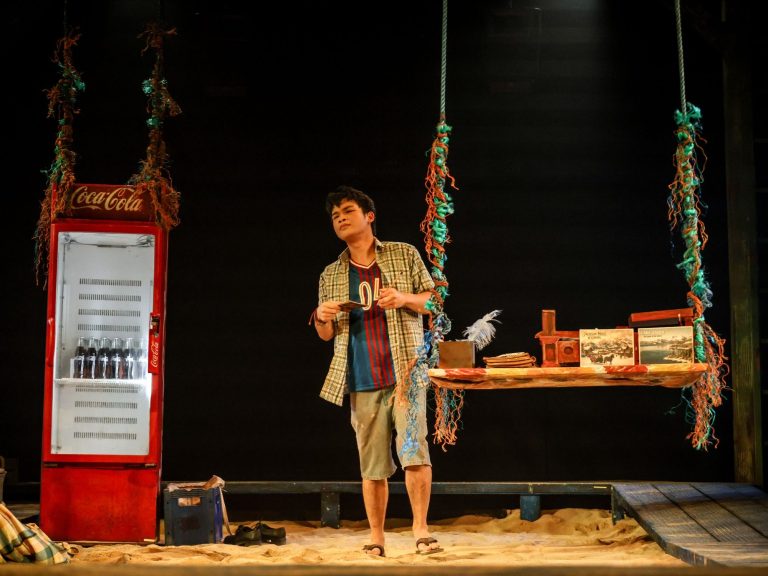
Photo by Myra Ho
Unrealistic Ambitions and Heavy Tolls
At its absolute core, Yemaya explores the brutal, eternal clash between youthful idealism and the uncompromising harshness of reality. Mulo is the ultimate idealist, spinning grand, utterly unrealistic fantasies about buying up commercial shops, living in luxury hotels alongside the nation's leader, and easily sailing away to a idealized version of America. Throughout his journey, he encounters a variety of pragmatic, weary people who try their best to reason with his stubborn, unyielding desires. Mulo remains fiercely resistant to their warnings, but the play handles his stubbornness without judgment, choosing instead to show the natural consequences of his blind optimism. Learning the true difference between a dream and reality ultimately requires paying a devastating personal price, and the narrative maps that emotional toll with heartbreaking precision.
Comic Beginnings, Tragic Depths
The collective reaction of the theater audience speaks volumes about the emotional control this production wields. The room dynamically shifts from widespread laughter and joy during the witty character banter and high-energy domino games to an absolute, breathless silence the exact second the more serious, tragic events begin to unfold. Watching the faces of the crowd, you could see a profound mix of curiosity, sadness, and genuine wonder. Yemaya pulls off a brilliant artistic bait-and-switch, expertly tricking the viewer into expecting a lighthearted, comedic slice-of-life adventure before pivoting sharply into an evocative, haunting journey of grief, survival, and lost innocence. It stands as an absolute must-watch for anyone who loves deeply felt coming-of-age stories, as well as theatergoers who appreciate atmospheric, highly imaginative staging that continues to linger in the mind long after the final lights go dark.
Yemaya is running until July 5, 2026 at the Black Box Theatre at the Proscenium, Rockwell.
Produced by 9 Works Theatrical.