
REVIEW: anthropology by Lauren Gunderson — When Artificial Intelligence Reflects Our Humanity
By: Anthea Magpantay
Published March 24, 2026
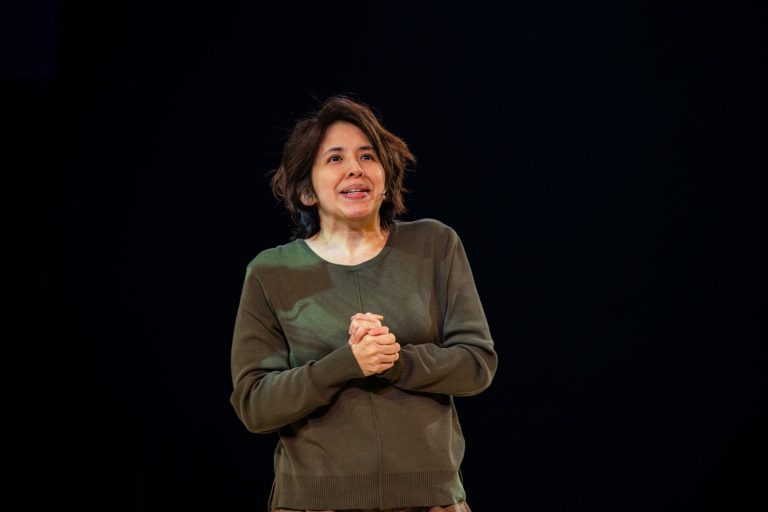
Jenny Jamora as Merril | Photo by CJ Ochoa
What happens when technology learns to speak in the voice of someone you love?
That unsettling question sits at the heart of anthropology, Lauren Gunderson’s thought-provoking play about grief, memory, and the growing presence of artificial intelligence in our lives.
When I entered the Doreen Black Box Theater at the Arete in Ateneo, I deliberately chose not to read anything about the play beforehand. All I knew was that it involved artificial intelligence, and even that detail I learned less than twenty minutes before the show.
What drew me in was something simple yet intriguing: the production had an all-female cast (plus with a female director, Caisa Borromeo) It was the first time I had watched a play without male characters, and during International Women’s Month it felt like an especially fitting choice.
As it turned out, it was more than fitting. It was an excellent decision.
The story centers on Merril (played by Jenny Jamora), a brilliant coder struggling with the disappearance of her sister Angie (sharply played by Maronne Cruz). In an attempt to cope with the silence her sister left behind, Merril builds an artificial intelligence trained on Angie’s digital traces: messages, recordings, and fragments of an online life that together begin to resemble the person she lost.
What begins as an attempt to preserve memory slowly evolves into something far more unsettling. The AI version of Angie is not simply a tool that repeats what Merril already knows. Instead, it begins revealing information Merril herself had not considered. In one of the play’s most gripping turns, the program begins guiding Merril toward clues about Angie’s disappearance, transforming a coping mechanism into an obsessive search for the truth.
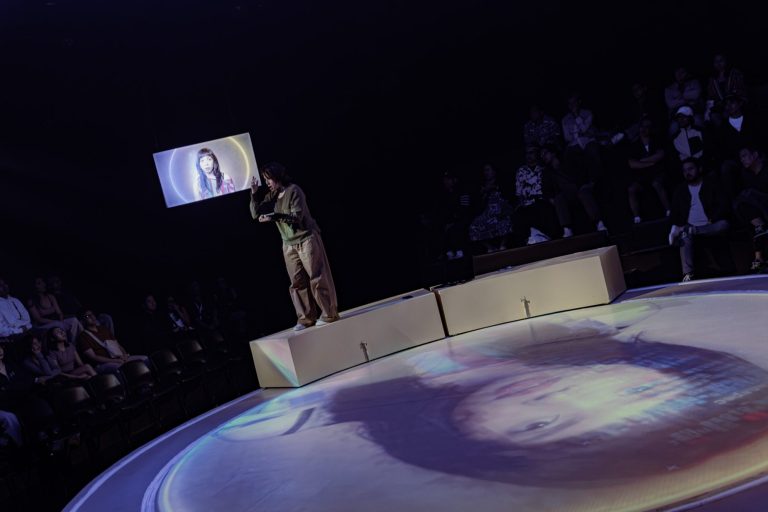
Photo by CJ Ochoa
AI as a mirror of emotions
At its core, anthropology suggests that artificial intelligence is not merely a tool we control. It can also become a mirror reflecting our deepest emotions. Grief, longing, guilt, and unresolved questions all find their way into the technology Merril creates.
Interestingly, the AI version of Angie is also portrayed as less temperamental and more light-hearted than the sister Merril remembers. The difference is subtle but striking. This digital Angie feels like a softened version of the real person. Watching this unfold made me think about how we curate ourselves online. The personas we leave behind through texts, posts, and recordings are often slightly brighter, wittier, or stronger than who we really are. In that sense, AI Angie may not simply be a reconstruction of the real Angie. She may also be a reflection of how we want ourselves to be remembered.
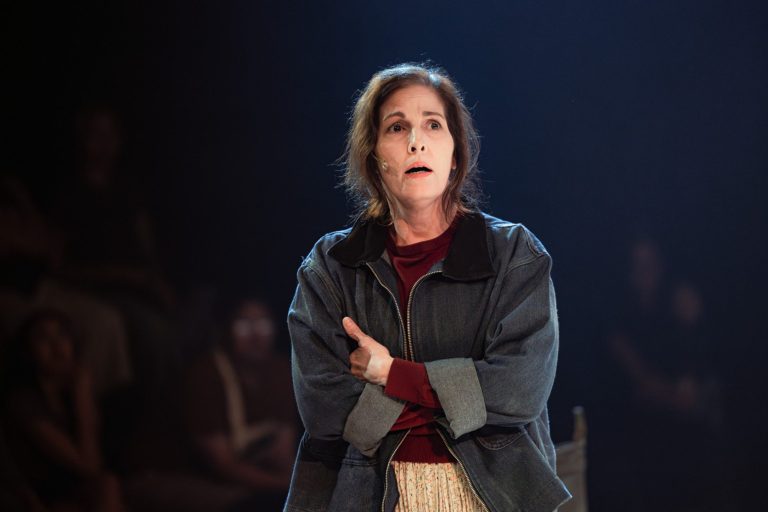
Jackie Lou Blanco as Merril's mother | Photo by CJ Ochoa
Watching the play made me think about how much of ourselves we already leave behind in the digital world. Our texts, voice notes, photos, and search histories form a sprawling archive of who we are. When those fragments are gathered and analyzed by powerful algorithms, could they begin to resemble a version of us?
The play quietly invites us to confront that possibility: Is it ethical to recreate someone using their digital footprint? Should we one day start including instructions in our wills about how our data should be handled after we die?
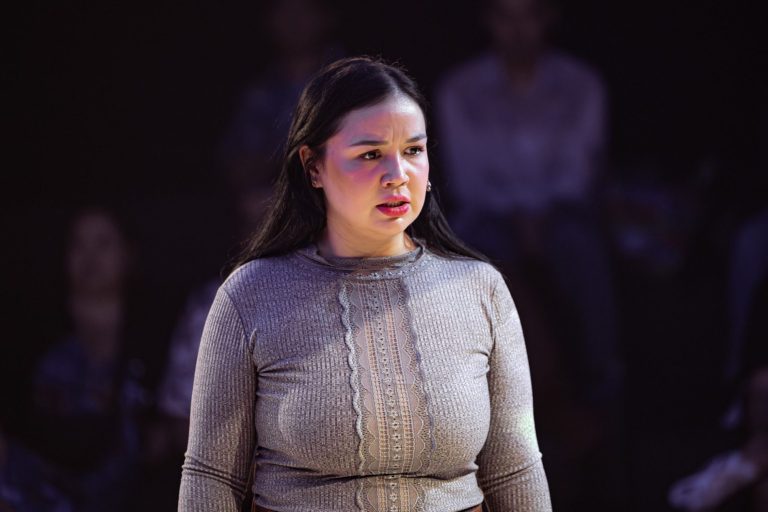
Mikkie Bradshaw-Volante is Raquel | Photo by CJ Ochoa
Jamora delivers a compelling performance as Merril. She captures the emotional tension of someone caught between technological curiosity and personal grief, allowing the audience to see how easily fascination can turn into fixation. Mikkie Bradshaw-Volante is Raquel, the ex-girlfriend of Merril, who keeps everything grounded. It's my first time to watch Bradshaw-Volante in a non-musical but her excellent enunciation and calming prescence make Raquel a joy to watch. The mother of Merril, Brie, is played by veteran actress, Jackie Lou Blanco.
In an intimate space, the emotional depth each actor brings becomes especially rewarding to witness.
Kudos to director, Borromeo, for drawing out performances that are both nuanced and deeply affecting.
The production design by Sarah Facuri and the lighting by D' Cortezano, reinforce this tension beautifully. The stark white circular stage creates a controlled, almost laboratory-like environment. An overhead element that adjusts in height subtly reshapes the playing space, while lighting and projections provide context without overwhelming the story. Multiple screens give visual form to the digital presence of AI Angie, making the technology feel both innovative and slightly eerie.
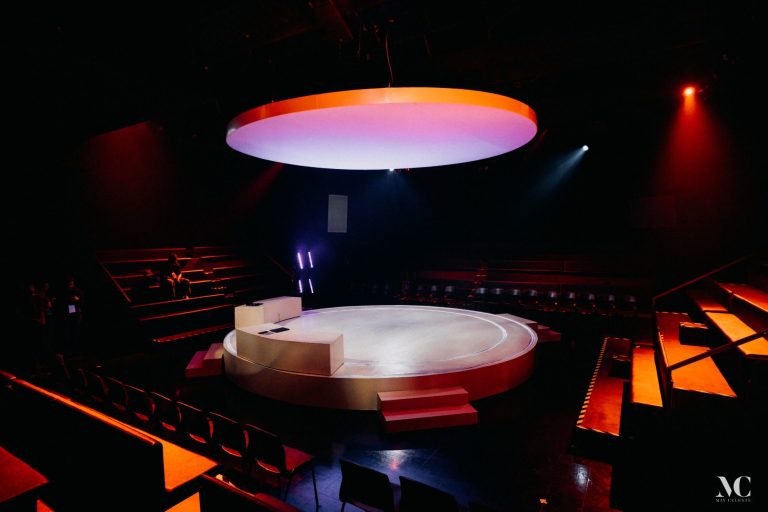
Stage design by Sarah Facuri. Lighting Design by D'Cortezano | Photo by May Celeste
When I left the theater, I carried with me a lingering sense of unease, not because the premise felt unrealistic, but because it felt entirely possible. Somewhere in the world, someone might already be attempting something very similar.
Which leads to a final thought: perhaps anthropology is no longer science fiction. The technology it imagines already exists. The only question is how, and how soon, we choose to use it.
Whatever label we give it, anthropology is a compelling theatrical experience that blends suspense with deeply human questions. It is a gripping and thoughtful drama that lingers long after the final scene.
anthropology by Lauren Gunderson is running until March 29, 2026 at the Doreen Black Box Theater, Arete in Ateneo de Manila University.
About the Author
Anthea is a lawyer and executive coach who helps professionals navigate significant transitions in their careers and lives. An enthusiastic theatergoer, she enjoys attending plays, concerts, and musicals and reflecting on the ideas they spark. Her writing explores the intersection of storytelling, humanity, and contemporary life.
Instagram: @anthea_magpantay