
The Bride! Review: Jessie Buckley and Christian Bale Electrify Maggie Gyllenhaal’s Gothic Horror
By Matty Haze
Published on March 31, 2026
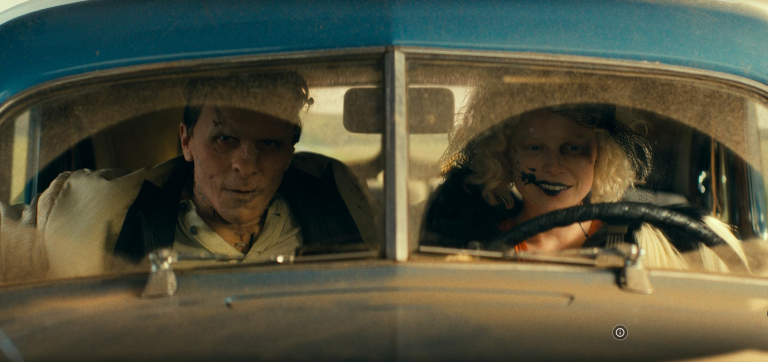
Christian Bale as Frank and Jessie Buckley as The Bride
★★★☆☆
In January 1818, Mary Shelley penned Frankenstein, and gothic literature found its heartbeat. The tale of a mad scientist stitching together a mosaic of the deceased to spark life into the grotesque is more than just "iconic" to me; it is the absolute blueprint. For over two centuries, Shelley's monster has stood shoulder-to-shoulder with the ultimate heavyweights of horror: The Wolf-Man, The Mummy, The Creature from the Black Lagoon, and, of course, the Count himself, Dracula.
Through countless adaptations, re-imaginings, and even the occasional questionable crossover, Frankenstein became a household name. Yet, despite the monster's enduring legacy, Shelley never penned a sequel, leaving a void that filmmakers have been trying to fill for decades. Most notably, the 1935 classic introduced his "Bride," though she was famously relegated to mere minutes of screen time.
Enter director Maggie Gyllenhaal. Known for her powerhouse performances in The Dark Knight and Donnie Darko, Gyllenhaal steps behind the lens to bring us a remake that is as ambitious as it is star-studded. She hasn’t just brought a shovel to this grave; she’s brought a specialized crew. We have Oscar-award winner Jessie Buckley (Wild Rose, Hamnet), Christian Bale (The Dark Knight trilogy), Peter Sarsgaard (The Batman), and Oscar-award winner Penélope Cruz (Pirates of the Caribbean).
Gyllenhaal’s version promises a cocktail of creativity and subversion, but in her quest to reanimate this legend, has she successfully breathed new life into the genre, or is this just another case of too many cooks in the laboratory?
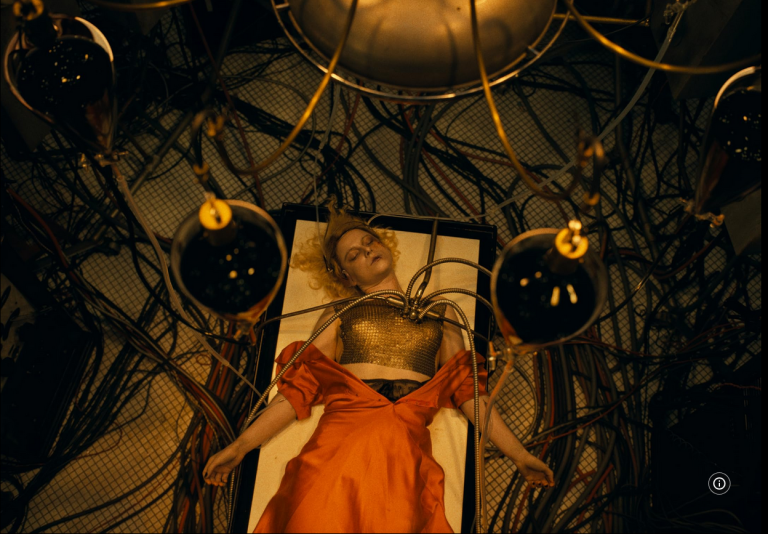
Jessie Buckley
Two Souls, One Body: When 19th-Century Rage Meets 1930s Grit
The stage is set in the 1930s, a world of smoke-filled eateries and dangerous men. We meet Ida (Jessie Buckley), a "party girl" and companion to low-level mobsters who spend their nights in a dive owned by the ruthless crime boss, Lupino. Just as we settle into what feels like a standard noir, the film takes a hard left into the metaphysical. The ghost of Mary Shelley herself, apparently riddled with "sequel regret," decides to possess Ida. The result is a jarring, schizophrenic descent where Ida flips between 1930s street slang and sophisticated, 19th-century British tirades, publicly dragging Lupino for his moral failings. Naturally, this doesn’t end well for her; a "little fall" leads to a broken neck, and Ida becomes a corpse.
Meanwhile, a century-old Frank (Christian Bale), the original monster, is living a lonely life in the shadows, finding his only joy in the silver-screen performances of Ronnie Reed (played by Jake Gyllenhaal). Seeking a cure for his isolation, Frank tracks down Dr. Euphronius (Annette Bening) and convinces her to join him in some light graverobbing. They exhume Ida and begin the experiment. When she awakens, she isn't just Ida; she’s a chaotic hybrid with Shelley still spouting nonsense inside her head. What follows is a Bonnie and Clyde odyssey that attempts to shake the foundations of society, leaving the audience to wonder if we should be rooting for the lovers or reaching for the pitchforks.
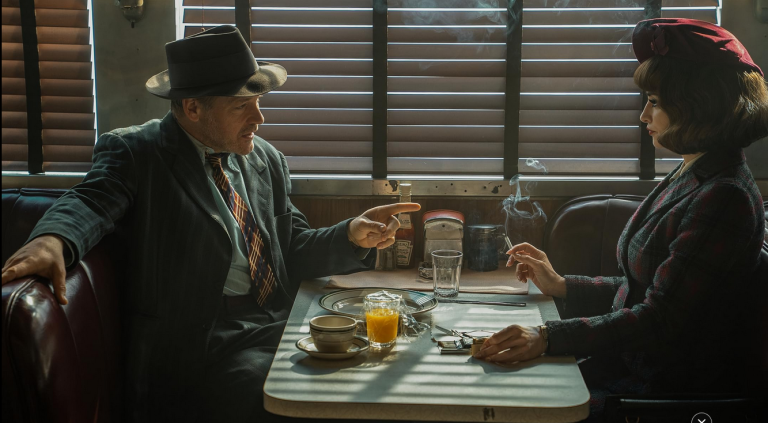
Peter Sarsgaard and Penélope Cruz
Jekyll, Hyde, and the Ghost of a Better Subplot
If acting were the only metric for success, The Bride! would be an easy masterpiece. Buckley delivers a career-defining performance that feels like a raw, unfiltered twist on the Jekyll and Hyde trope. She moves effortlessly from a discarded, broken woman to a feral symbol of rebellion, avoiding every "monster" cliché in the book. Instead of a creature, she becomes a movement, a sparking wire of inspiration.
Opposite her, Bale provides a fascinatingly "soft" version of the legendary monster. He plays Frank as a cinema-obsessed romantic, a misunderstood creature whose greatest desire is simply to fit into a world that doesn’t believe a man like him should exist. Their chemistry is the lightning that powers the film.
However, the "stitching" begins to unravel when we look at the supporting cast. The Mafia subplot is severely underutilized, eventually becoming little more than an afterthought. While Sarsgaard and Cruz bring undeniable weight as detectives, their characters feel like archetypes pulled from a completely different movie. The Mafia, partially responsible for Ida's creation, never truly becomes the driving force the story needs. We see Lupino early on, a man ruthless enough to collect body parts from his victims and shoot his own henchmen, and it feels like a massive missed opportunity. Having the mob boss serve as the final obstacle could have propelled the movie to greatness; instead, he’s left behind in the first act.
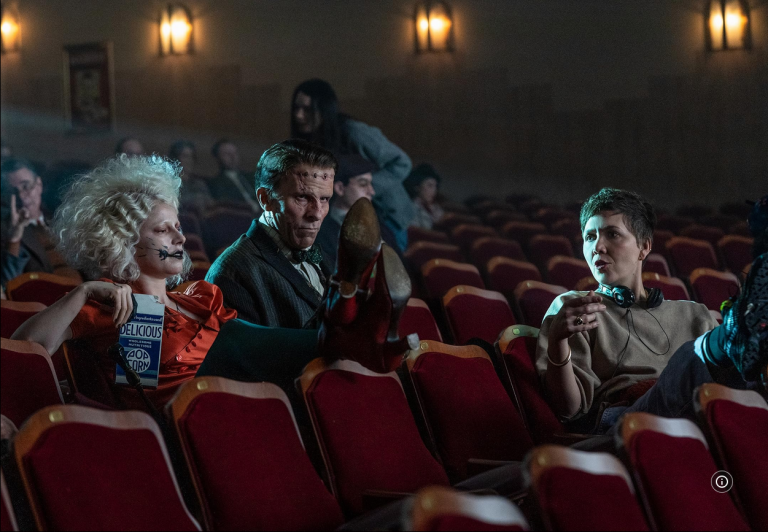
Sound and Vision: A Gothic Masterpiece Trapped in a Fragmented Story
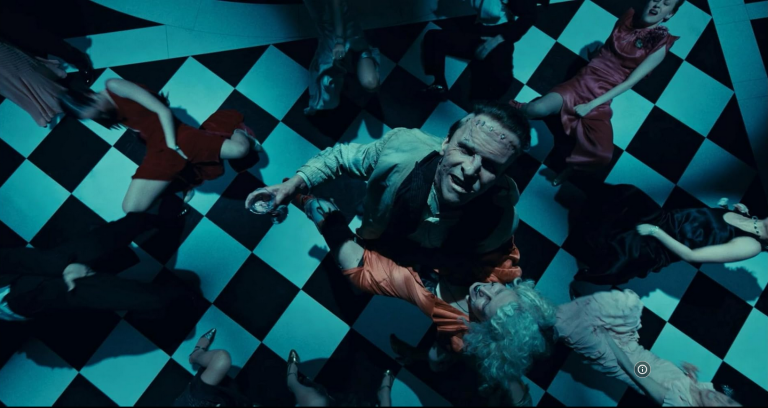
Visually, the film is a triumph. Cinematographer Lawrence Sher creates an atmosphere that drips with classic gothic horror. The palette is so dark that the blood looks like black ink, creating a murky tone that clashes beautifully with the noisy, criminal underworld of Chicago. Sher captures the Bride with an otherworldly allure, making her look less like a reanimated corpse and more like a hauntingly beautiful statue, a gothic Mona Lisa. The film's aesthetic can almost be described as a colorless graphic novel, engulfed in a moody, sometimes absurdly stylish tone.
The sound design is equally impressive, perfectly capturing the eerie tension of the 1800s met with 1930s jazz. Hildur Guðnadóttir’s score is a masterclass in atmosphere, utilizing a distorted, humming tune that signals the Bride’s presence. The auditory immersion is so deep it "sucks you in," making you feel like a resident of this twisted Chicago. However, the sheer amount of stimulation can occasionally become overwhelming. When the screen is busy and the "punk rock" soundtrack is blaring, the sensory overload might be the point, but it often drowns out the narrative weight. Again, it’s a shame this technical brilliance wasn't utilized to flesh out the missing Mafia presence.
Aesthetics Over Autonomy: Why the Bride’s Movement Misses the Mark
Thematically, the film wears its heart on its sleeve: female autonomy and the right to self- authorship. Gyllenhaal crafts a fascinating narrative by literally placing the author within her own creation, allowing Shelley to participate in the universe she built. This hybrid of the Bride and the Author is a brilliant vehicle for exploring rebellion against societal norms. It asks: how were women treated then, and how should they be treated now?
The problem is that the Bride’s rise as a "punk icon" feels shallow. She looks the part, and her aesthetic certainly inspires a movement within the film, but it doesn’t feel earned. For a social critique to land, the audience needs to see the villainy of the system. Because the Mafia is virtually non-existent for the bulk of the runtime, the "rebellion" is just two people on the run from the law. The film desperately needed to show us the crimes and injustices the Mafia inflicted on helpless women to make the Bride’s vengeance a compelling social critique. Without that weight, the "revolution" feels more like a fashion choice than a fight for freedom.
Reanimated but Restrained: Why This New Legend Needed a Tighter Stitch
Ultimately, The Bride! is a visual gothic treat. It is a bold, fascinating study of autonomy that manages to be both a monster movie and a tragic romance. Jessie Buckley and Christian Bale are undeniably the heart of this experiment, giving life to horror icons in ways we haven’t seen before. The "cool factor" is oozing out of every frame, and there is clear potential for a 5-star masterpiece buried under the surface.
Unfortunately, like Frankenstein's creation, the movie is a bit of a "messy story" held together by sheer willpower. The underdeveloped Mafia subplot acts as a drag on the pacing, preventing the film's deeper messages from truly landing. It is a brilliant step forward for Gyllenhaal as a director, but one that perhaps needed a few more stitches to hold the narrative together.
Final Verdict: 3/5 ★★★☆☆
Photos screenshots from IMDB.